
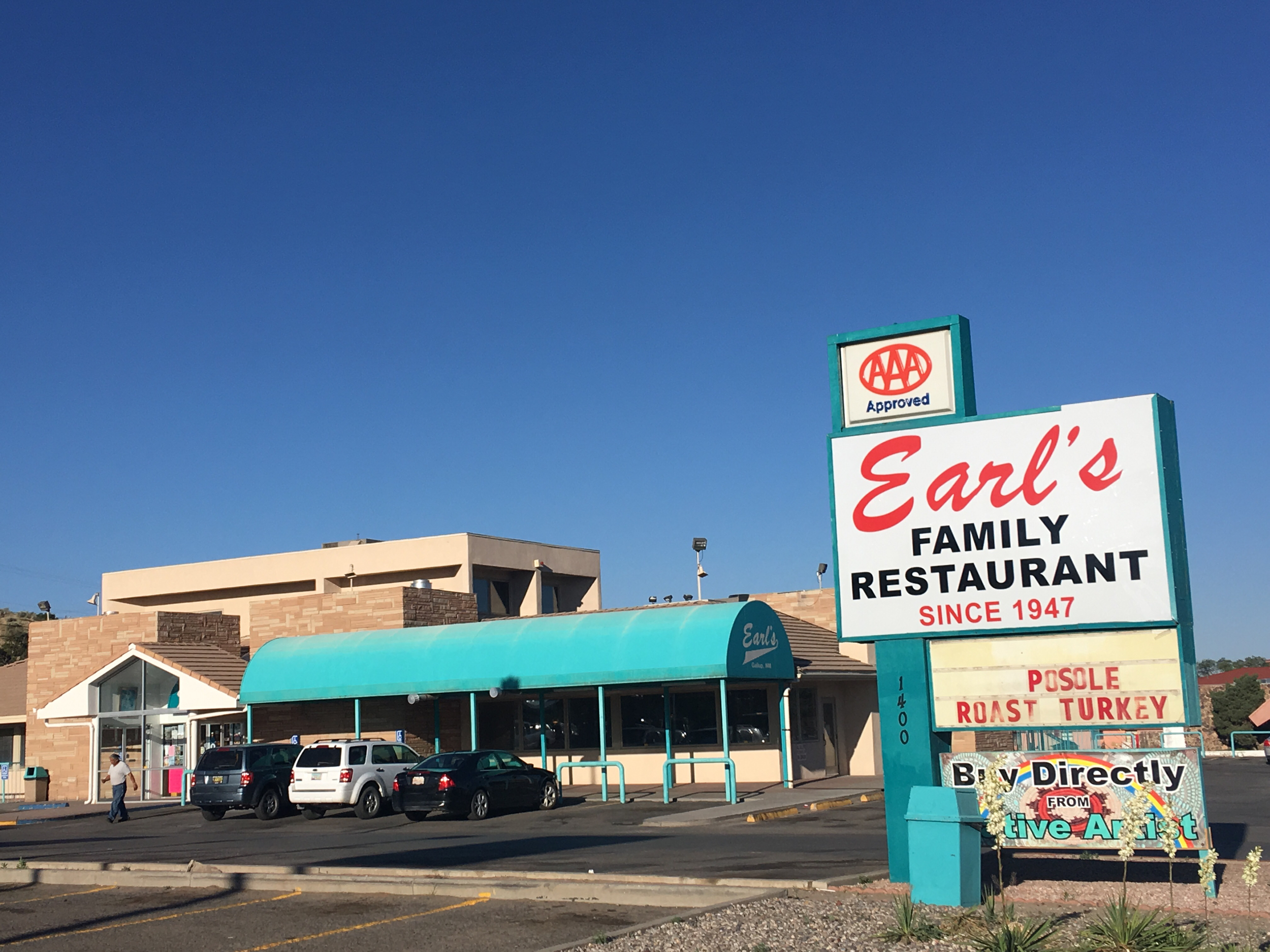
Photo: Earl’s Restaurant (Gallup) (Some rights reserved)
Local Travel = Travel within one’s own neighborhood or region; Travel with someone in their own neighborhood or region // Viajar dentro del propio vecindario o región; Viajar con alguien en su propio vecindario o región
In our examination of ‘local travel’ we will examine the spectrum from being hyperlocal and attentive to pword to traveling beyond the immediate horizon and finding ways of connecting where one is the foreigner. Why?
Travel and tourism impact local communities, in positive and negative fashion. The questions we explore on this website begin with a diagnosis of how travel does and does not connect visitors with locals and vice-versa. Do people want to be connected or left alone?
Questions // Preguntas
- What would locals like visitors to know? // ¿Qué les gustaría a los locales que los visitantes supieran?
Essay
Everywhere is local somewhere.
Imagine how travel could be interpreted if we valued not only the experience of the visitor but the local as well. We talk about traveling like a local instead of thinking of how we could travel with locals and in ways that contribute to cultural and natural conservation as well as the well-being of local people.
Exotic places are someone else’s home.
The default position thinking about travel and tourism – from the advertisements to travel guides and rating systems – is the focus on the traveler’s experience.
We are longtime superfans of the movements toward local and hyperlocal – we want to know what’s growing in the fields, what birdsong we hear, what fruit and veg is in season. And if there is access to a garden and kitchen, even better. Apply this to travel and tourism and there are countless opportunities to make connections.
Local travel is frequently eco travel. We’d place the relationship between the local travel movement and ecotourism as one of mutual camaraderie.
In my early vision of ecotourism (1997) – see the not so crappy graph – the local community is an integral component. No meaningful engagement equals not ecotourism.
If there is no community participation, engagement and profit, there’s no ecotourism, nor responsible travel nor conscious travel, nor anything we should be promoting.
Too often ecotourism has focused on environmental conservation, selling the ecotours that sweep in and out of a protected area. Visitors rush by in a mad dash, a quest for check-the-box, stamp-the-book, visit-the-park worldview. Locals are barely seen and mostly unheard.
In contrast, I think what the conscious travel offer is a way to contextualize place in a way that deepens the meaning and engagement of locals and visitors.
The challenge was and is listening to locals and supporting the wishes from the community. At times there is conflict and visitors – nationals and foreigners – should be supporting consensus rather than taking sides and deepening tensions.
Pictured here is Earl’s Family Restaurant in Gallup, New Mexico. Good food meets good people on the road, Route 66 style. This third place becomes a sit-down marketplace as artisan vendors come by the tables in a quiet manner to sell their crafts. As a traveler on I-40, this place has been a family favorite for 30 years. The restaurant is AAA-approved and has the sign to show it! Navajo tacos, sweet rolls and green chile stew — excellent food.
On the global stage we are figuring out how to measure and rank the overall happiness within countries. (Thank you, happiness.
Strong, local travel providers contribute to their localities as catalysts of creativity, innovation and employment. Strengthening – or at the very least not undermining these operators – will go a long way toward building the resilience of local economies in uncertain times. My personal ‘reading’ of local travel focuses more on developing the capacity of locals so that they can make the most of their visitors without treating them as walking wallets.
Local travel to me is a world beyond ‘bums on seats’ and delves into the face-to-face contact that many locals and travelers are seeking (some via the smartphones). This is the movement in which we can nurture the nexus of local-visitor interaction simply by exploring this together.
Why travel? A beautiful view is no longer enough. Locals and visitors are more engaged when stories are shared. Locals provide context, they share the knowledge and experiences of what went before, of what is expected in the future, of how to appreciate the moment in the present. Locals can identify sounds, scents and help distinguish when the visual overlay becomes complex.
Tips for Locals
If you want visitors …
• Introduce yourself
• Invite them to visit
• Be thankful and attentive to the visitors already present
Consejos para la gente local
Si deseas los visitantes …
• Preséntese
• Invítelos a visitar
• Sé agradecido y atento a los visitantes ya presente
More Questions // Más Preguntas
- How do you define local travel? // ¿Cómo defines los viajes locales?
Headlines
What Do We Mean When We Say “Local?” – Rooted
Stray Notes
- In South Africa, local is lekker!
- Visitors are planning and dreaming and later on remembering the trips beyond the actual travel time.
Planeta